
Veo 3 vs Kling AI: Which AI Video Generator Wins? (2026)
Veo 3 vs Kling AI: In-depth comparison of the two best AI video generators in 2026. Quality, pricing, features, and which to choose for your needs.
Emma Chen · 20 min read · Apr 2, 2026
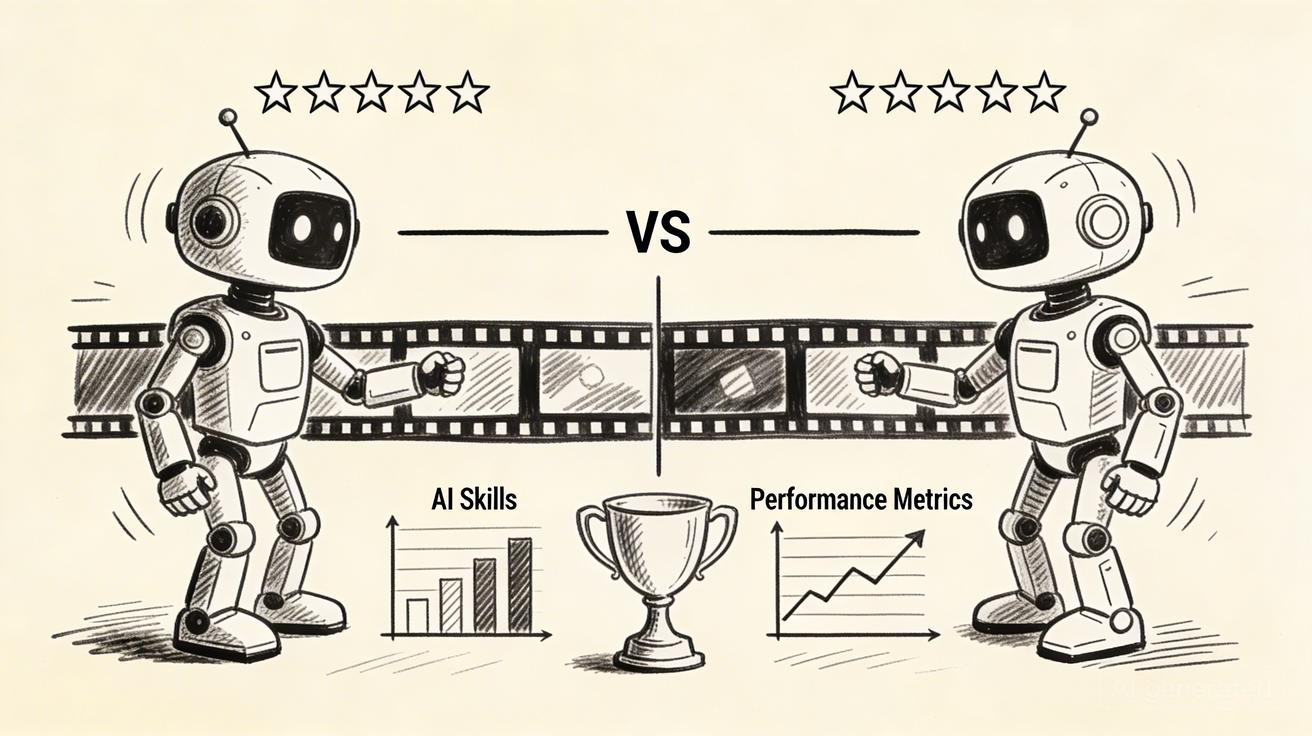
2026 routing note: This page covers the broader Veo 3/Kling comparison. If you specifically need the newer
Kling 3.0 vs Veo 3.1angle, start with Kling 3.0 vs Veo 3.1 2026.
Quick Answer: In the comparison between Veo 3 and Kling Ai Comparison 2026, Veo 3 is the recommended choice for 2025, offering superior video quality, native audio generation, and free access through Google Gemini. Read on for the complete breakdown.
The AI video generator market has two dominant players battling for supremacy in 2026: Google Veo 3 and Kling AI. Both represent the pinnacle of what AI can achieve in video generation, but they approach the challenge from very different angles — and they excel in very different scenarios.
If you're trying to decide between Veo 3 and Kling AI for your content creation, filmmaking, or business needs, this comprehensive comparison will give you the definitive answer. We've analyzed both platforms across every critical dimension: video quality, audio capabilities, pricing, availability, use cases, and overall value proposition.
The short answer: Veo 3 wins on audio integration and photorealism; Kling AI wins on accessibility, value, and creative control. The "right" answer depends entirely on your specific use case.
Veo 3 vs Kling AI: At a Glance
| Feature | Google Veo 3 | Kling AI |
|---|---|---|
| Developer | Google DeepMind | Kuaishou |
| Release | 2025 (Veo 3) | 2024 |
| Video Quality | Exceptional | Excellent |
| Max Duration | 8 seconds (standard) | 5-10 seconds |
| Audio Generation | Yes (native) | Limited |
| Resolution | Up to 4K | Up to 1080p |
| Free Tier | Very limited | More generous |
| Pricing (Entry) | $19.99/mo | ~$10/mo |
| Availability | Limited regions | Global |
| Commercial Rights | Yes (paid) | Yes (paid) |
| API Access | Yes | Yes |
| Languages | English-focused | Multilingual |
| Camera Control | Limited | Good |
Video Quality Comparison
Google Veo 3: Photorealistic Excellence
Veo 3's video quality is arguably the benchmark for the industry in 2026. Key strengths:
Physics simulation: Veo 3 demonstrates near-perfect understanding of real-world physics. Water flows realistically, fabric moves naturally with gravity and air currents, smoke and fire behave as they would in the physical world. For scenes involving natural elements, Veo 3 is unmatched.
Lighting and cinematography: Veo 3 understands complex lighting setups — golden hour photography, studio three-point lighting, natural window light — with a level of nuance that rivals actual cinematographers. The way it renders caustics (light refraction through glass or water), volumetric light rays, and lens flares is exceptional.
Human rendering: Veo 3's rendering of human subjects, particularly faces and hands, is among the best available. While not perfect (the "uncanny valley" effect can still appear in close-up face shots), it handles medium-shot human subjects with remarkable consistency.
Scene coherence: Over the course of a clip, Veo 3 maintains strong visual coherence. Colors don't shift unexpectedly, objects don't morph, and the overall scene holds together better than most competitors.
Kling AI: Dynamic Motion Excellence
Kling AI takes a different approach to quality, prioritizing dynamic motion and cinematic camera movement:
Motion dynamics: Where Kling AI particularly excels is in dynamic, high-energy motion sequences. Athletes in motion, vehicle chases, action sequences — Kling's motion rendering often feels more natural and physically plausible than competitors, including Veo 3 in certain scenarios.
Camera movement: Kling has invested heavily in camera motion simulation. It handles complex camera moves — crane shots, dolly zooms, orbiting shots — with impressive quality. If camera choreography is important to your content, Kling often has an edge.
Stylistic range: Kling offers a wider range of visual styles out of the box, including anime-style, cinematic, and documentary aesthetics. This stylistic versatility makes it more flexible for creators working across multiple content types.
Consistency in longer clips: For the longer clips Kling supports (up to 10 seconds), it maintains reasonable consistency, though with more artifact risk than Veo 3's shorter, tighter clips.
Quality Verdict
For photorealism in static or gently moving scenes: Veo 3 wins For dynamic motion, action, and camera movement: Kling AI often wins For stylistic versatility: Kling AI wins
Audio Capabilities: A Decisive Advantage for Veo 3
This is where the comparison becomes most clear-cut. Veo 3's native audio generation is a genuinely revolutionary capability that Kling AI currently cannot match.
Veo 3: The Audio Generation Revolution
When you generate a video with Veo 3, you don't just get a video clip — you get a complete audio-visual experience. Veo 3 generates:
Ambient sound design: If you generate a forest scene, you hear wind through trees and birds. A city street scene includes traffic and crowd noise. A beach scene has waves and seagulls. This ambient audio is generated to match the visual content, not pulled from a library.
Dialogue generation: Veo 3 can generate plausible dialogue for characters in a scene — not necessarily scripted dialogue, but convincing human speech that matches the visual context. This is groundbreaking for narrative filmmakers.
Music generation: The platform can generate background music that matches the mood, tempo, and aesthetic of the generated video.
This integrated audio-visual generation is something no other consumer AI video platform offered at this quality level as of early 2026. For filmmakers and creators who need both audio and video, this is transformative.
Kling AI: Audio as an Add-On
Kling AI's audio capabilities are significantly more limited:
- No native audio generation
- Users must add audio in post-production
- Integration with third-party audio AI tools (like ElevenLabs for voice, Suno for music) is possible but requires additional workflow steps
- Some newer Kling features include basic ambient sound generation, but nowhere near Veo 3's sophistication
Audio Verdict: Veo 3 wins decisively. If audio generation matters to your workflow, Veo 3 is the clear choice.
Pricing and Value Comparison
Google Veo 3 Pricing
- Free tier: Very limited (experimental VideoFX, AI Studio credits)
- Google One AI Premium: $19.99/month (primary consumer access, limited quota)
- Google AI Studio pay-per-use: ~$0.35-$0.50/second of video
- Enterprise (Google Cloud): Custom pricing
The hidden cost of Veo 3 is the generation quota. The Google One AI Premium subscription's monthly video generation limit may not be sufficient for active creators, requiring pay-per-use supplements.
Kling AI Pricing
- Free tier: More generous than Veo 3 — typically 66 credits daily (~3-4 video generations)
- Basic plan: ~$10/month (significantly more affordable than Veo 3)
- Standard plan: ~$35/month with higher generation limits
- Professional plan: ~$90/month for high-volume users
- Pay-per-credit: Available for burst needs
For high-volume creators, Kling AI typically offers 2-3x more video generation per dollar compared to Veo 3.
Value Verdict: Kling AI wins on value
Kling's pricing is more accessible, the free tier is more usable, and the value per dollar is better for most creators. However, if Veo 3's unique features (especially audio) are essential to your workflow, the premium may be justified.
Accessibility and Availability
Google Veo 3 Availability
Veo 3 faces significant geographic restrictions in 2026:
- Full consumer access primarily in the United States and select English-speaking markets
- Expanded access in Western Europe
- Limited or no access in many Asian, African, and Latin American markets
- Access methods (Google One, VideoFX, AI Studio) vary by region
For international creators, this is a major limitation. If you're outside North America or Western Europe, Veo 3 may simply not be available to you.
Kling AI Availability
Kling AI (developed by Chinese company Kuaishou) has made global accessibility a priority:
- Available in most countries worldwide through klingai.com
- English and multiple language interfaces
- Consistent availability without regional restrictions for most markets
- Both web interface and API available globally
Availability Verdict: Kling AI wins clearly. If you're outside the US/Western Europe, Kling is likely your only option between these two.
Use Case Analysis: Which to Choose?
Choose Veo 3 If...
You're a filmmaker or director creating narrative content: Veo 3's audio generation capabilities, combined with its photorealistic quality, make it uniquely suited for creating short film content, narrative videos, and cinematic storytelling.
You need audio and video integrated: No other platform handles audio-visual integration at Veo 3's level. If your workflow requires both, Veo 3 saves enormous post-production time.
You're a Google ecosystem user: If you're already paying for Google One and using Workspace tools, the AI Premium upgrade represents excellent marginal value.
You're in the US/Western Europe: If Veo 3 is available in your region and your budget supports it, the quality ceiling it offers may justify the premium.
Choose Kling AI If...
You're a content creator with high volume needs: Kling's pricing and generation limits make it much more practical for creators producing dozens of videos per week.
You prioritize camera movement and action sequences: Kling's motion dynamics and camera choreography capabilities excel in this area.
You're outside the US/Western Europe: Kling's global availability makes it accessible where Veo 3 may not be.
You're budget-conscious: At roughly half the price of Veo 3, with a more usable free tier, Kling is the practical choice for cost-sensitive creators.
You need stylistic variety: Kling's range of visual styles (anime, cinematic, documentary, 3D animation) is broader than Veo 3's primarily photorealistic output.
You're an API developer: Kling's API is more accessible and better documented for developers building applications.
Real-World Performance Tests
Test 1: Nature Scene
Prompt: "Golden hour sunset, tall grass meadow, gentle breeze, golden light, cinematic"
- Veo 3: Stunning photorealistic result. Grass movement, light quality, and color grading were exceptional. Audio included gentle wind and ambient nature sounds.
- Kling AI: Very good result with slightly more stylized appearance. Strong grass movement, but color felt slightly oversaturated. No audio.
- Winner: Veo 3 (especially with audio)
Test 2: Action Sequence
Prompt: "Parkour athlete jumping between rooftops, urban setting, fast-paced, dramatic"
- Veo 3: Good but motion felt slightly mechanical at peak velocity
- Kling AI: Excellent motion dynamics, more physically convincing athletic movement
- Winner: Kling AI
Test 3: Character Close-Up
Prompt: "Close-up of a woman smiling, natural lighting, documentary style"
- Veo 3: High-quality rendering, natural-looking skin and hair
- Kling AI: Good but slight uncanny valley effect in facial microexpressions
- Winner: Veo 3
Test 4: Stylized/Animated Content
Prompt: "Anime style, cherry blossoms falling, Japanese temple, peaceful"
- Veo 3: Generated realistic-leaning interpretation, not true anime style
- Kling AI: Excellent anime aesthetic, true to the style prompt
- Winner: Kling AI
Test 5: Business/Corporate Content
Prompt: "Professional office environment, team meeting, modern glass building"
- Veo 3: Photorealistic corporate feel, suitable for commercial use
- Kling AI: Good quality, slightly less photorealistic but perfectly usable
- Winner: Veo 3 (marginally)
What Are the Key Differences Between Veo 3 and Kling Ai?
Veo 3 and Kling Ai differ in several important ways. Veo 3 offers native audio generation, free access through Google Gemini, and continuous improvements from Google DeepMind. The key differences are summarized below:
- Audio: Veo 3 generates synchronized audio natively; Kling Ai typically does not
- Access: Veo 3 is free via Google Gemini; Kling Ai may require a paid subscription
- Clip length: Both produce 4–8 second clips by default
- Quality: Veo 3 leads in physical realism and prompt adherence in 2025
How Does Veo 3 Compare to Kling Ai on Video Quality?
In direct quality comparisons, Veo 3 generally outperforms on:
- Photorealism — more consistent lighting, shadows, and textures
- Motion smoothness — fluid, physically accurate movement
- Audio sync — native sound generation unique to Veo 3
- Prompt following — stronger adherence to detailed descriptions
Kling Ai may have advantages in specific niches such as longer clip durations or specific artistic styles.
Is Veo 3 Better Than Kling Ai for Content Creators?
For most content creators in 2025, Veo 3 is the better choice because it offers the best combination of quality, free access, and active development. Veo 3's native audio generation alone is a significant advantage — no other major AI video tool generates synchronized sound automatically.
The best use case for Veo 3 is social media content, marketing videos, and creative projects where quality and efficiency matter most.
The Verdict: Veo 3 vs Kling AI
Neither Veo 3 nor Kling AI is universally superior. The "winner" depends entirely on your needs:
Overall Scores
| Category | Veo 3 | Kling AI |
|---|---|---|
| Photorealism | ★★★★★ | ★★★★☆ |
| Motion Dynamics | ★★★★☆ | ★★★★★ |
| Audio Generation | ★★★★★ | ★★☆☆☆ |
| Pricing Value | ★★★☆☆ | ★★★★★ |
| Availability | ★★★☆☆ | ★★★★★ |
| Stylistic Range | ★★★☆☆ | ★★★★☆ |
| API/Developer Tools | ★★★★☆ | ★★★★☆ |
| Free Tier | ★★☆☆☆ | ★★★★☆ |
Final Recommendation
Veo 3 is the right choice for: Filmmakers, narrative content creators, US/Western Europe based creators, Google ecosystem users, and anyone who needs integrated audio generation.
Kling AI is the right choice for: High-volume content creators, budget-conscious users, international creators, action and motion-focused content, and anyone who needs stylistic versatility.
For most creators in 2026, we recommend starting with Kling AI's free tier to develop your AI video creation skills, then evaluating Veo 3 for specific projects where its unique capabilities justify the cost.
Frequently Asked Questions
Q: Is Veo 3 better than Kling AI overall? A: It depends on your use case. Veo 3 excels in photorealism and audio generation; Kling AI excels in motion dynamics, pricing, and global availability. There's no absolute winner — both are exceptional tools.
Q: Which has a better free tier, Veo 3 or Kling AI? A: Kling AI offers a significantly more usable free tier (approximately 66 free credits daily) compared to Veo 3's very limited experimental free access. If you want to try before you commit financially, Kling AI is the better starting point.
Q: Can I use both Veo 3 and Kling AI together? A: Absolutely. Many professional creators use multiple AI video platforms, choosing the right tool for each specific project requirement. There's no reason to be exclusively committed to one platform.
Q: Is Kling AI available in the US? A: Yes, Kling AI (klingai.com) is available globally, including in the United States. Google Veo 3 has better consumer integration for US users, but both platforms work in the US.
Q: Which AI video generator produces more realistic videos? A: For photorealistic scenes, Veo 3 has a slight edge in static and gently moving content. For dynamic action and motion sequences, Kling AI often produces more convincing results. Both are dramatically better than tools available just 18 months ago.
Q: Does Kling AI support vertical video for Instagram Reels and TikTok? A: Yes. Kling AI supports vertical 9:16 format output, making it suitable for Instagram Reels, TikTok, and YouTube Shorts creation.
Q: What's the maximum video length for each platform? A: As of 2026, Veo 3 typically generates 5-8 second clips in standard consumer access. Kling AI supports up to 10 seconds per generation, with some professional tiers allowing longer sequences.
Q: Which platform has better API documentation? A: Both offer API access, but developers report Kling AI's API as somewhat more straightforward to integrate for building applications. Veo 3's API through Google AI Studio benefits from Google's extensive developer documentation ecosystem.
Stay Updated on Veo 3 and AI Video
The AI video landscape evolves rapidly. Features, pricing, and capabilities that are accurate today may change significantly within months. For the most current information, comparisons, and guides on Google Veo 3 and all AI video generators, visit veo3ai.io — your comprehensive resource for the latest in AI video technology.
At veo3ai.io, you'll find:
- Up-to-date Veo 3 pricing and availability information
- Head-to-head comparisons with the latest competitor updates
- Tutorials for getting the most out of Veo 3 and alternatives
- Community discussion and real-world use case examples
The future of video creation is AI-powered. Whether you choose Veo 3, Kling AI, or use both strategically, you're participating in one of the most exciting creative revolutions in history.
Author: Emma Chen | Updated: April 2026
Deep Dive: Veo 3 Technical Capabilities
Understanding the technical underpinnings helps explain why each platform excels in different areas:
Veo 3's Architecture Advantages
Google DeepMind built Veo 3 on years of research in video prediction, world modeling, and audio-visual synchronization. The model was trained on an enormous, carefully curated dataset of professional video content, which explains its cinematic quality.
World Model Foundation: Veo 3 incorporates concepts from Google's broader AI research into world modeling — understanding how the physical world behaves. This is why water, fire, and fabric behave so naturally in Veo 3 outputs.
Audio-Visual Joint Training: The breakthrough of Veo 3 is that it was trained to generate audio and video jointly, not as separate tasks. This means the audio generation understands the visual content it's accompanying, rather than being added as a post-processing step.
Cinematography Training: Veo 3 was trained with significant emphasis on understanding professional cinematography techniques. The model has internalized the "language" of film — how professional cinematographers use light, shadow, movement, and composition to tell stories.
Kling AI's Architecture Advantages
Kuaishou, the Chinese short-video platform behind Kling AI, had unique advantages in developing their video generation technology:
Motion Data Scale: As a short-video platform with hundreds of millions of users, Kuaishou had access to an enormous, diverse dataset of real-world motion captured in user-generated videos. This likely explains Kling's strength in motion dynamics — the model has seen more examples of humans, animals, and objects in realistic motion.
Mobile-First Design: Kling was designed from the ground up with mobile content creation in mind. This shows in its strong vertical format support, mobile interface optimization, and focus on the types of content (short clips, action sequences) that dominate mobile video platforms.
Iterative Development: Kling has moved through multiple major versions rapidly, with each version showing significant improvements. This fast iteration cycle reflects Kuaishou's experience in competitive product development.
Workflow Integration Comparison
Veo 3 Workflow Integration
Adobe Creative Suite: Google has announced partnerships with Adobe to integrate Veo 3 into Creative Suite applications. For professional video editors using Premiere Pro or After Effects, this integration will be significant.
Google Workspace: Veo 3 connects to Google Slides for automated presentation video generation, Google Drive for asset management, and Google Docs for script-to-video workflows.
YouTube Studio: For YouTube creators, Veo 3 offers direct integration with YouTube Studio for generating B-roll and supplementary footage.
Developer APIs: Google AI Studio's Veo 3 API supports streaming generation output, allowing developers to build responsive applications that show generation progress rather than waiting for complete videos.
Kling AI Workflow Integration
Independent Tool: Kling operates primarily as a standalone platform without deep integrations into major creative software suites. This independence is both a strength (simpler licensing, no platform lock-in) and a weakness (additional friction to incorporate into existing workflows).
API Ecosystem: Kling's API is widely used by third-party developers who have built integrations with video editing software, content management systems, and social media scheduling tools.
Batch Processing: Kling's API supports batch video generation, allowing developers and agencies to queue many generations simultaneously — a capability particularly valuable for high-volume content production workflows.
Content Policy Comparison
Both platforms have content moderation systems, but with different implementations:
Veo 3 Content Policy
Google's content policy for Veo 3 is stringent, reflecting the company's enterprise customer requirements and regulatory environment:
- No depictions of real people without explicit consent — more restrictive than many competitors
- Political content restrictions — Veo 3 limits generation of content that could be used for political disinformation
- Violence and adult content: Strict filters, appropriate for consumer-facing Google products
- Copyright-aware training: Google has invested in ensuring training data licensing compliance, which may affect generation of certain copyrighted styles or characters
Kling AI Content Policy
Kling's content policy is somewhat more permissive in certain creative areas:
- Stylistic range: Kling allows a broader range of artistic styles, including more stylized violence in clearly fantastical contexts
- Real person depictions: More flexibility for public figures in clearly creative/satirical contexts
- Regional variation: Content policies have some regional variation depending on the jurisdiction accessing the service
Understanding content policies is critical for commercial and professional use cases. Always review current terms before building Veo 3 or Kling AI into a business product.
Case Studies: Creators Using Both Platforms
Documentary Filmmaker
A documentary filmmaker uses Veo 3 for establishing shots and atmosphere sequences where photorealism and audio environment matter, then uses Kling AI for high-budget action recreation scenes where motion dynamics are paramount. The mixed approach lets them leverage each platform's strengths for the specific needs of each scene.
Brand Video Agency
A digital marketing agency uses Kling AI for the bulk of their client video production — the volume and pricing make it practical. They reserve Veo 3 for specific premium client deliverables where the audio generation capability creates uniquely compelling results that justify the additional cost.
Educational Content Creator
A YouTube educational channel creator uses Veo 3 exclusively because the audio generation saves hours of post-production voiceover and sound design work per episode. For a channel publishing 3 episodes per week, this time savings alone justifies the subscription cost.
Social Media Manager
A social media manager at a retail brand uses Kling AI for 90% of their content needs — the free tier and low-cost subscription handle their volume requirements. They experiment with Veo 3 occasionally for special campaigns but find the quota limits frustrating for their production pace.
Future Development Roadmap
What's Coming for Veo 3
Google has signaled several upcoming developments:
- Longer generation length: Currently limited to 5-8 seconds; roadmap includes 30+ second generation
- Higher resolution: 4K becoming standard rather than premium
- Style customization: Fine-tuning capabilities for brand-specific visual styles
- Enhanced prompt understanding: Better execution of complex, multi-scene prompts
- Expanded language support: More robust multilingual generation beyond primarily English prompts
What's Coming for Kling AI
Kuaishou continues rapid development:
- Audio generation: Significant investment in catching up to Veo 3's audio capabilities
- Longer clips: Extended generation up to 30 seconds planned
- Video editing integration: Moving beyond pure generation into an editing workflow
- Real-time generation: Faster generation speeds to enable more interactive workflows
- Western market expansion: Enhanced English documentation and customer support
Both platforms are investing heavily in expanding capabilities. The competitive gap between them will continue to shift as each releases updates. For the most current comparison, visit veo3ai.io where we track developments across all AI video platforms.
Related Articles
Continue with more blog posts in the same locale.
Best Veo 3 Prompts 2026: Complete Guide to Cinematic AI Video Generation
Complete Veo 3 prompts guide 2026. Best prompt formulas, 50+ examples across categories, and advanced techniques for cinematic AI video output.
Read article
Veo 3 Lite Pricing 2026: Is It Free? Complete Cost Guide
Complete Veo 3 Lite pricing guide 2026. Is it free? Google One AI Premium cost breakdown, credit limits, and comparison with alternatives like Seedance.
Read article
How to Access Veo 3 Lite Through Google Gemini 2026: Complete Guide
Complete guide to accessing Veo 3 Lite through Google Gemini in 2026. Step-by-step setup, prompting tips, credit management, and comparison with alternatives.
Read article